Our ideals and often our practices are glorious and maniacal, as were the ideals and practices of those who went before us, so long ago.
Nicholas Poussin, whom I met doing this series of blogs, is a classically oriented, cerebral painter, usually of idyllic, unemotional scenes. A monograph from the Metropolitan Museum of Art has him as an inspiration for Jean-Jacque David, Paul Cezanne', and Pablo Picasso.
Poussin's Death of Germanicus. . .

might have inspired David's awful Death of Socrates.

Poussin's Rape of at the Sabine Women

could have inspired David's revolutionary Intervention of he Sabine Women.

Picasso is easy. The Poussin self-portrait:

. . . the El Greco Portrait of an Artist. . .

to Picasso's version.

Cezanne is hard, and I don't think I can get it because I'm not a colorist, but I'll try.
Poussin's The Triumph of Neptune. . .

and Cezanne's The Bathers, perhaps.

Poussin's "most Baroque" painting, and my excuse for this Codex, is the Martyrdom of St. Erasmus, which shows a Roman soldier pulling the saint's intestine out of his body and winding it on a windlass.
The painting is kept in a Vatican museum and the Vatican won't exhibit a copy,
Commercial artists have made the color vidid and perhaps more than Poussin would have made then. Do you prefer a vivid red and a pale sky

. . . or a vivid sky and muted reds?
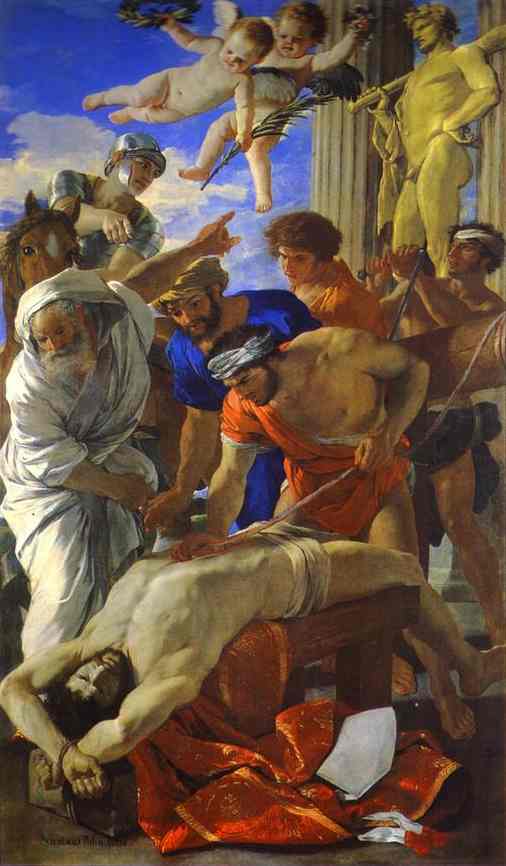
Hundreds of artists offer a version of the Martyrdom os St. Erasmus, by Poussin and earlier painters, are on he Web. The paintings are, one supposed, popular with Christians or Sadists oar Christian Sadists, who want to display it in their homes.
An earlier Martyrdom of St. Erasmus (the Flemish painter Dirk Bouts, before 1466)

has acquired a following.
Do you prefer chic indirect lighting. . .

or glorious sunlight, for cocktails?


A dutch cartoon from about 1460

A detail of a painting by the Dutch Henricus Satrapitanus 1516
The my mind's eye I see
Poussin's Martyrdom of St. Erasmus hanging on the wall of a dining chamber deep within the Vatican, to which only prelates of highest rank and most refined taste are ever invited, there to share with their Pope, the former Nazi youth, a meal of Spaghetti swerved in an exquisite Marinara Sauce . . . .
Well, perhaps I do the prelates a disservice. Indeed, I would do them a disservice if only I had the power to do one.
You killed him!
You killed him!
In your god damn Brooks Brothers suit,
You Son of a Bitch.
Alan Ginsberg, Howl. Clerical robes will serve just as well as a suit of good English cloth.
The history and legend of the Church of the martyrdom of St. Erasmus is both glorious and mad. Per Wikipedia, the saint was
beaten around the head,
beaten with leaden mauls until his veins broke
thrown into a pit of snakes and worms, and
boiling oil and sulfur were poured on him.
At this point God electrocuted all his torturers.
Then he was
thrown in another pit, but an angel came and slew all the vipers and worms.
Then he was
put into a pan seething with rosin, pitch, brimstone, lead, and oil, which was poured into his mouth
a searing hot cloak and metal coat were tried on him. An angel eventually carried him away to safetyThen he was
enclosed in a barrel full of protruding spikes, and the barrel was rolled down a hill. But an angel healed him.
Then
his teeth were plucked out of his head with iron pincers
Then
they roasted him upon a gridiron
and so forth.
Finally (and this is what the paintings are about),
his stomach was slit open and his intestines wound around a windlass.
There is no record of his having been water boarded, for which I suppose we should all be thankful.
if you think of the 16th and 17th Centuries as the bad old days and believe we have "improved", and wish to see what the Pol Pot did to Cambodians, visit a Greek site, Metal on Metal. A sample, by Van Nath, a Cambodian artist who survived a Pol Pot concentration camp:

And yes, water boarding is torture, you heartless monsters in our own government.
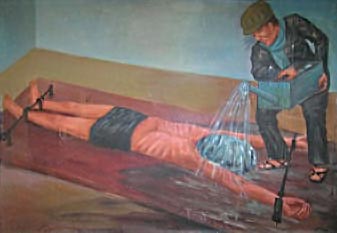
We -- you and I and all the rest of those who call ourselves , so carelessly, "Americans" -- cause lots of suffering in the world: flesh burned from bodies, babies suffocated, mauling, mutilations, blasted to smithereens; and so do those who wish us in the West ill; and so do those who are indifferent to us altogether (we are innocent of the suffering of Uighurs, for example).
But unless scenes of torture were painted by a 17th Century Master, we don't display them on the walls of our homes or public buildings (except Fine Art Museums and, presumably, Catholic Sadists' homes); at least we don't display them for evangelical purposes.
No. We have the decency to hide images of torture away on the Web, where only some one billion school-aged children may view them and download them, and share them with sniggering friends (do young'ns still snigger? I expect they are too sophisticated for that ) causing . . . Well, we'll find out what it causes. All we have to do is wait for the future to happen. I hope exposure is better than the secrecy I grew up with.
In the meanwhile, to view some of the images, you'll have do your own search; or visit my "adult" blog -- easily available to five-year-olds --: The Burning Font, now under construction.
Do I contradict myself? Very well, then I contradict myself, I am large, I contain multitudes.
Walt Whitman, Song of Myself


